
Plywood sheets may look similar in a showroom, yet they can perform very differently after exposure to humidity, cleaning, or plumbing leaks. This makes plywood grade selection important for both furniture quality and long-term cost.
In an MR vs BWR vs BWP plywood comparison, MR means Moisture Resistant, BWR means Boiling Water Resistant, and BWP means Boiling Water Proof. These terms mainly describe the durability of the adhesive bond under defined test conditions. They do not mean that every part of a panel is immune to unlimited water exposure.
This guide compares their bonding systems, core construction, moisture performance, applications, certification, and value.
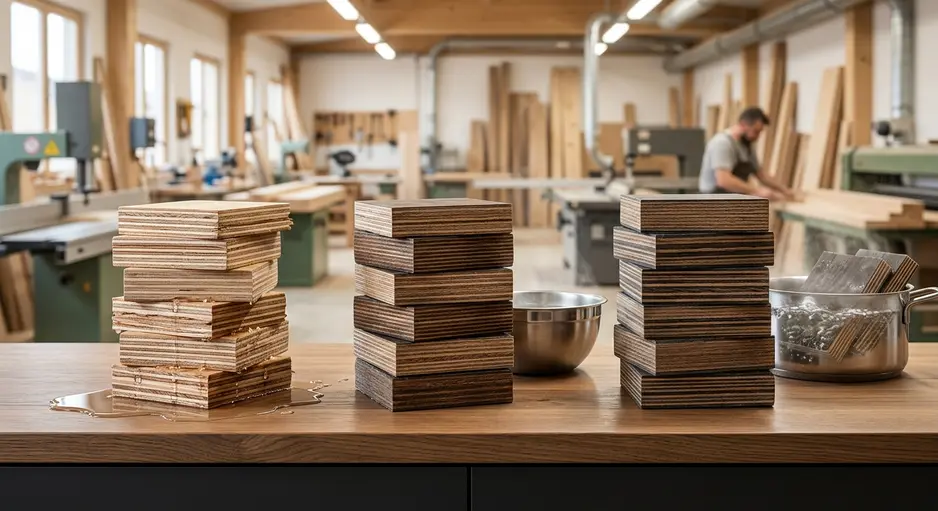
MR plywood is designed mainly for dry indoor furniture. Many MR panels use a urea formaldehyde resin-based adhesive, although the exact formulation varies by manufacturer.
This grade can handle normal indoor humidity and brief contact with dampness. However, it should not face repeated splashes, leaks, or prolonged exposure to water. Laminate may protect its surface, but it does not change the underlying plywood grade.
Common applications include:
BWR plywood stands for boiling water resistant plywood. It has stronger bonding and better delamination resistance than interior MR panels. Manufacturers may use fortified or other water-resistant adhesive systems, so buyers should confirm performance through certification and test records.
BWR is often selected for kitchens, utility rooms, commercial interiors, and furniture used in humid climates. It offers a practical middle ground when the moisture risk is meaningful but marine-grade performance is not required.
BWP plywood stands for boiling water proof plywood. It is intended for demanding locations where repeated moisture exposure is likely. Marine and BWP products are commonly associated with phenol formaldehyde resin or another compliant bonding system, but resin claims should always be supported by technical documents.
In India, genuine marine plywood is generally linked to IS 710. Because “BWP” is sometimes used broadly in the market, buyers should not rely on the printed name alone. Certification, licence details, and documented test results provide stronger proof.
MR plywood suits dry interior furniture, BWR plywood suits humid or occasionally wet areas, and BWP plywood provides the strongest bond protection for demanding kitchens, bathrooms, and leak-prone spaces.
| Comparison factor | MR plywood | BWR plywood | BWP plywood |
|---|---|---|---|
| Full form | Moisture Resistant | Boiling Water Resistant | Boiling Water Proof |
| Typical environment | Dry interiors | Humid or occasionally wet areas | Demanding high-moisture areas |
| Common bonding system | Often UF-based | Water-resistant system; formulation varies | Often phenolic or equivalent compliant system |
| Moisture resistance | Basic | Higher | Highest of the three |
| Delamination resistance | Limited during prolonged exposure | Stronger than MR | Designed for stringent conditions |
| Dimensional stability | Suitable for dry interiors | Better in humid conditions | Best when well-made and sealed |
| Typical uses | Bedrooms and offices | Kitchens and utility furniture | Sink units, vanities, and demanding kitchens |
| Relative cost | Lowest | Mid-range | Highest |
| Relevant Indian standard | Commonly IS 303 | Commonly IS 303 | IS 710 for marine plywood |
Grade is only one part of quality. Veneer selection, plywood core composition, pressing, core gaps, bonding consistency, and edge protection also affect service life.
Adhesive holds each veneer layer together. Heat and water can weaken a poor bond, causing layers to separate. Many interior panels use urea formaldehyde resin, while higher grades may use fortified or phenolic systems designed for better bond durability.
Dark glue lines do not prove that a sheet is waterproof. Likewise, BWP is not always guaranteed to use one universal resin recipe. The relevant standard, plywood grade certification, and test report matter more than resin colour or sales claims.
Good hardwood plywood construction depends on more than adhesive. Properly dried veneers, balanced layers, uniform thickness, and minimal gaps help the sheet remain flat. They also improve screw holding and dimensional stability.
Large gaps, overlapping veneers, or uneven pressing can create weak areas. Water may enter these spaces through exposed edges or hardware holes. Even a high-grade label cannot fully make up for poor core construction.
A boiling water test or cyclic test checks how well bond lines resist failure under defined conditions. Claims such as “eight-hour” or “72-hour” protection should be assessed against the applicable standard, conditioning method, and laboratory report.
In India, the IS 1734 series covers methods of testing plywood, while IS 848 addresses synthetic resin adhesives. A home boiling test may reveal obvious bond failure, but it cannot replace controlled laboratory testing.
Water resistance and termite resistance are separate features. A water-resistant sheet is not automatically protected against insects. Buyers should request documents for any termite resistant treatment instead of assuming that all BWP products include it.
MR is usually the best-value answer to which plywood is best for interior furniture in dry rooms. It works well for beds, shelves, wardrobes, office desks, and decorative units when there is no contact with plumbing or wet floors.
Choose a suitable thickness for the expected load. Seal exposed edges and avoid placing the furniture against damp walls.
The best plywood for kitchen cabinets depends on the exact location. MR may be considered for dry lofts or sections with very little moisture risk. BWR is often suitable for upper cabinets and other moderately humid areas.
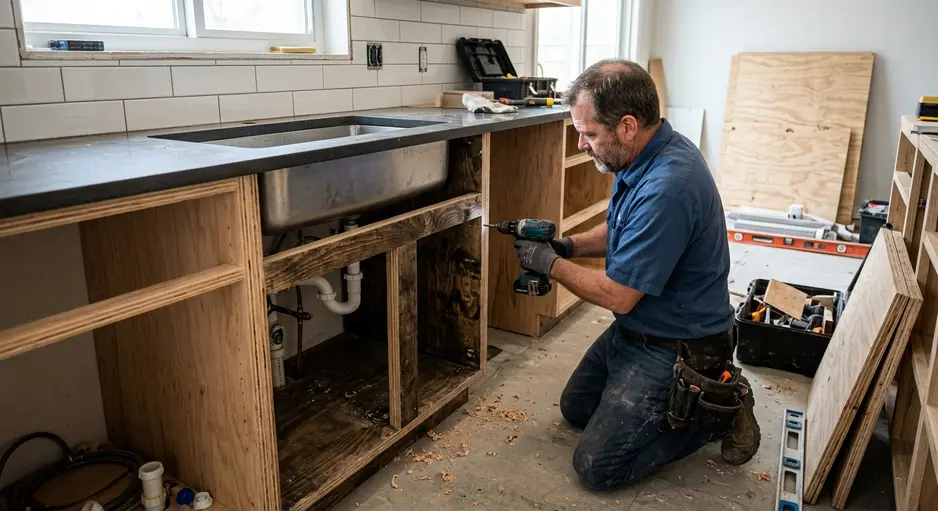
BWP is the safer choice for sink cabinets, base units, and sections beside a dishwasher or water line. A wall-mounted spice cabinet mainly faces humidity. A sink-base cabinet may face condensation, leaking pipes, and wet cleaning, so it needs stronger protection.
Certified BWP is generally the best plywood for bathroom furniture such as vanity units and storage cabinets. However, no wood-based panel should remain in standing water.
Seal cut edges, grooves, joints, screw holes, and hardware openings. A sound laminate or coating, good ventilation, and clearance from a wet floor will further reduce water absorption and finish damage.
Plywood grades for furniture manufacturing should be standardized by application. A factory may use MR for dry internal parts, BWR for humid locations, and certified BWP for sink or vanity units.
This risk-based system is useful for modular furniture, hotels, restaurants, institutions, and retail fixtures. It controls cost without using a low grade in a high-risk area.
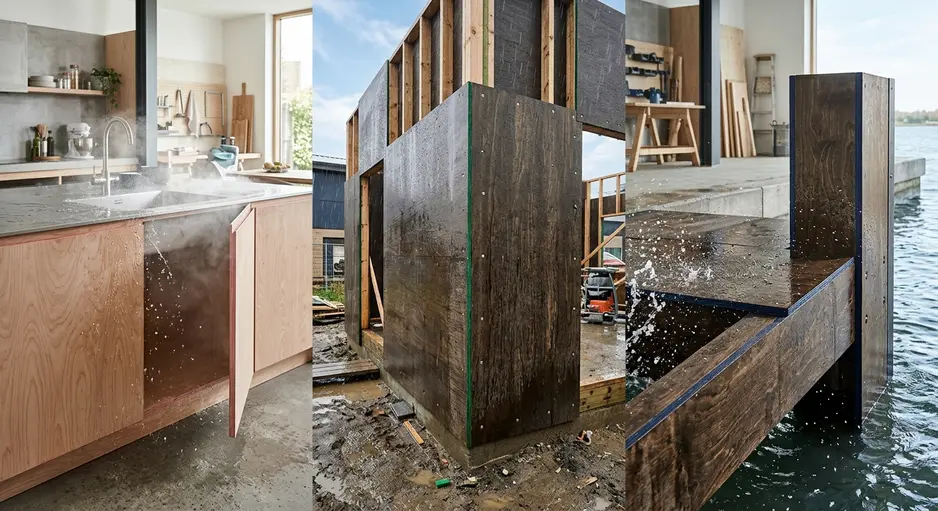
BWP describes resistance to bond failure under specified conditions. It does not mean wood fibres cannot absorb water. Long immersion may still cause swelling, fungal growth, surface damage, or failure of the decorative finish.
No. Laminate reduces exposure across the covered face, but edges, joints, drill holes, and damaged sections remain vulnerable. Applying laminate does not turn moisture resistant plywood into BWR or BWP plywood.
Not always. BWP is widely used as a market term, while genuine marine plywood in India should meet the requirements of IS 710. Verify the ISI mark, CM/L licence number, invoice description, and supporting documents before accepting a marine-grade claim.
Examine sheets for flatness, consistent thickness, damaged corners, open glue lines, warping, and uneven sanding. Visible edge gaps or overlapping core veneers may point to poor construction.
Compare sheets of the same thickness and grade. Large weight differences can justify further checks, although weight alone does not establish quality or a specific water absorption rate.
Evaluate lifecycle value, not only the price per sheet. Replacements, service calls, and damage to finished furniture may cost more than selecting the correct grade at the start. Buyers can review Suntek Ply’s available product specifications, certifications, application guidance, and supply support before making a decision.
Explore Best MR & BWR & BWP Plywood
The practical MR vs BWR vs BWP plywood choice is simple: use MR for dry interiors, BWR for humidity and occasional dampness, and BWP for demanding kitchens, bathrooms, and leak-prone units.
Do not overpay for BWP in every dry application, but do not compromise around sinks or plumbing. Certification, veneer quality, bonding strength, core composition, installation, and edge sealing matter as much as the label.
Explore Suntek Ply’s plywood range or contact its product team to compare grades, specifications, certifications, and supply options for residential, commercial, dealer, or furniture-manufacturing requirements.
BWR offers stronger resistance to humidity and occasional water exposure. MR is more economical and suitable for dry indoor furniture. The better option depends on where the panel will be installed.
In a BWR vs BWP plywood decision, BWP provides higher bond durability for demanding moisture exposure. BWR may offer better value for furniture in moderately humid areas.
MR can be used in dry, low-risk kitchen sections. BWR or BWP is preferable near sinks, plumbing, wet floors, and appliances that produce moisture.
Cutting exposes the veneer edges, which can absorb moisture. Seal all cut edges, grooves, joints, and hardware holes during fabrication to protect the panel.
For marine-grade performance, check the IS 710 marking, ISI mark, CM/L number, manufacturer details, invoice description, and supporting test documents. Do not rely only on a “BWP” stamp.
