
Furniture makers, architects, contractors, and dealers often need panels that are easy to handle without giving up strength or stability. This is where block board can be a practical choice. It has a timber-strip core enclosed between veneer facing layers, creating a light yet dependable panel.
However, sheet thickness alone does not show quality. Core preparation, timber seasoning, bonding, calibration, and factory controls all affect performance. This guide explains what to check when choosing a block board plywood manufacturer in India or a block board plywood supplier in India for furniture, doors, interiors, or bulk orders.
Block board is an engineered wood panel. Its centre contains narrow timber strips arranged side by side. Veneers are bonded to both faces under pressure. This construction supports lightweight panel construction while providing stable edges for cutting, fixing, and finishing.
A softwood timber core can help reduce panel weight. A hardwood strip core may offer higher density for selected uses. Yet, one is not always better than the other. Results depend on the timber species, density, moisture level, bonding, strip size, and final application.
The strips should be properly seasoned and evenly sized. Poor drying can lead to movement after installation. Large core gaps may also reduce load bearing strength, surface quality, and screw holding capacity. Buyers should therefore look beyond the name of the core timber.
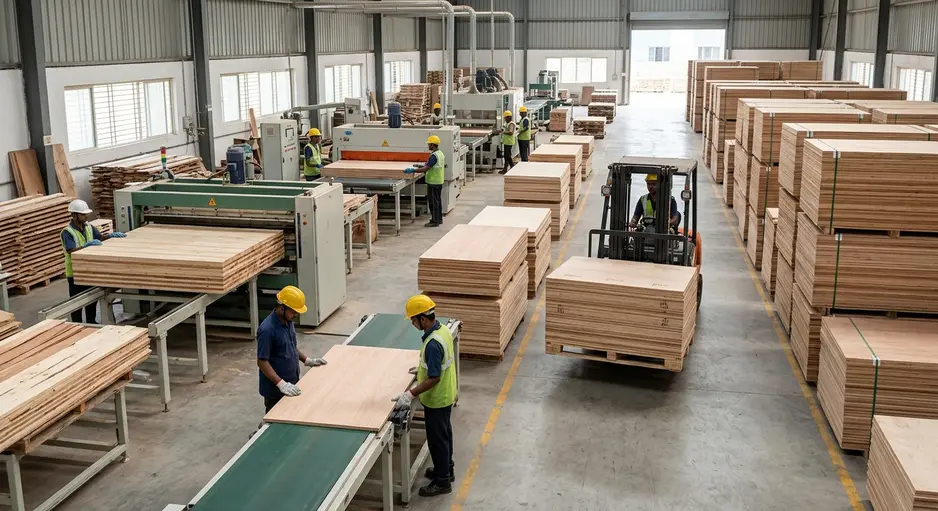
In a typical block board plywood factory, production starts with timber selection and seasoning. The timber is cut into strips, sized, and aligned to form the core. Adhesive is applied before veneer facing layers are placed on each side.
The assembly is hot pressed, trimmed, sanded, and checked for calibrated block board thickness. Inspection should cover bonding, core gaps, flatness, warping, edge separation, and surface defects. Care at each stage helps produce a panel that is easier to machine and finish.
A sound timber-strip core can provide useful edge stability. This matters when hinges, handles, channels, and other hardware must be fixed near a panel edge. Quality block board often provides better screw holding than many low-density fibre or particle panels.
Actual performance still depends on core density, void control, screw position, pilot-hole size, and installation method. A screw placed into a core gap will not perform like one fixed into a solid timber strip. Samples and cut-edge inspection can help buyers assess construction quality.
Block board is generally easier to lift and install than some dense engineered boards. Correct seasoning and bonding also support dimensional stability and warp resistance. These features can benefit tall shutters, doors, shelves, and selected long span furniture applications.
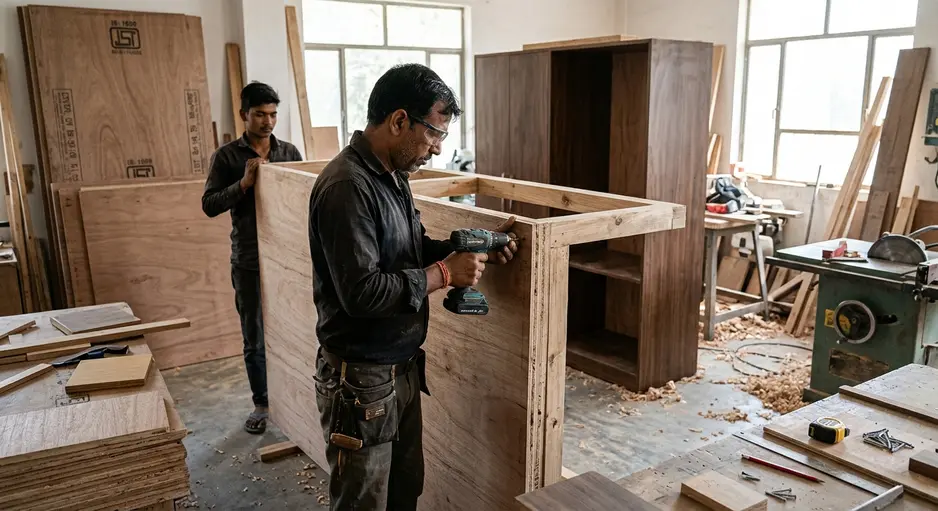
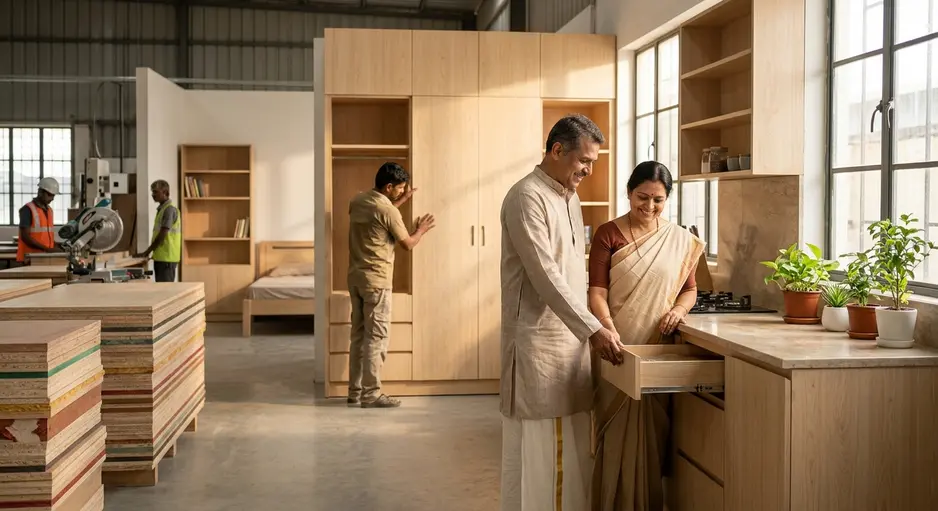
Common applications include wardrobe shutters, cabinet frames, tables, shelves, office furniture, partitions, and display units. Block board plywood for furniture is especially useful where lower panel weight and dependable edge fixing are important.
The best block board for wardrobes should have a uniform core, flat faces, suitable thickness, and a grade matched to indoor conditions. For a tall wardrobe shutter, a calibrated and well-seasoned panel can help maintain alignment while giving hinges a stable fixing base.
A block board plywood manufacturer for furniture industry orders should be able to clarify dimensions, tolerances, surface condition, and intended use. Furniture makers must also plan hinge spacing and hardware based on the shutter’s height, weight, and design.
Block board plywood for doors may be used for interior door shutters, tall cabinet doors, lightweight partitions, or specified flush-door components. Its timber core can support edge hardware while keeping the finished door manageable.
Entrance doors, wet areas, and exterior locations need special care. Buyers should not assume that an indoor panel is suitable for rain, standing water, or continuous humidity. The selected grade must be tested and warranted for the actual exposure.
Block board plywood for interior projects can suit shopfitting, counters, panelling, display fixtures, and supported shelving. For a long shelf, orient the core in the correct direction and calculate the likely load. Add intermediate supports or edge reinforcement when needed.
There is no universal winner. The right panel depends on the design, finish, exposure, loading, hardware, and budget. Buyers can use the following comparison as a starting point:
Choose block board for lightweight shutters, doors, edge hardware, and suitable long-span uses. Select plywood when multi-directional strength or a defined specification is required. MDF is often preferred for routed designs, while particle board can serve controlled, budget-focused indoor applications.
IS 1659 is the main Indian specification associated with block boards. When a seller makes an ISI or standards claim, request current licence details and verify that they apply to the offered product. A test report alone should not be treated as proof of an active licence.
Buyers can also ask for batch identification, grade information, and available test data. Relevant records may cover bonding, moisture, dimensions, workmanship, or other declared properties. The manufacturer should clearly state the panel’s intended end use.
Before approving an order, review a full sheet and a cut sample where possible. Use this practical checklist:
A block board plywood manufacturer controls production and factory quality. A block board plywood supplier focuses on availability and fulfilment. A block board distributor supports regional or high-volume supply, while a block board dealer often serves local buyers and smaller orders.
Furniture factories and large projects may benefit from direct manufacturer discussions about tolerances, repeat orders, and batch consistency. Smaller buyers may prefer a dealer who offers quick local delivery and easier replenishment.
Commercial grade block board is generally considered for dry interior applications. Moisture resistant block board is intended for specified indoor conditions where occasional humidity or moisture may occur. Buyers should match the declared grade to the real service environment.
Available block board sheets, dimensions, and thicknesses can vary. Before ordering, confirm the finished sheet size, actual thickness, stated tolerance, squareness, diagonal tolerance, and surface condition. Custom dimensions may require a minimum quantity and longer production time.
Consistent calibration is helpful for modular furniture and repeat production. It reduces avoidable variation during cutting, edge treatment, lamination, and assembly.
Common block board surface finishing options include decorative laminate, decorative veneer, paint, and polish after suitable preparation. Edges may be finished with lippings or edge bands. Adhesive selection and surface preparation should follow the instructions supplied with the board and decorative material.
Block board wholesale price varies because not all panels have the same core or production controls. The main cost factors include:
For a block board plywood bulk purchase, provide the application, exposure conditions, grade, sheet size, thickness, quantity, delivery location, and required schedule. Also state any testing, documentation, calibration, surface, or packaging needs. This makes quotations easier to compare.
Bulk buyers should ask about production capability, raw-material control, in-process checks, batch consistency, sample approval, lead times, and dispatch planning. The rejection and replacement process should also be clear before a large order is placed.
A pre-order sample should match the proposed specification. For repeat orders, agree on measurable points such as finished dimensions, thickness tolerance, surface condition, grade, and packing.
When evaluating a block board plywood export, confirm destination-country requirements, protective packaging, palletisation, container loading, commercial documents, and country-of-origin needs. Treatment or fumigation requirements and customs classification should be checked for the destination before dispatch.
Buyers can request a technical data sheet, product sample, current compliance documents, lead time, and project-specific quotation from Suntek Ply before placing a bulk or export order. Any certification, warranty, capacity, or export-market claim should be confirmed through current company documentation.
Block Board Plywood Manufacturer and Supplier in India
Selecting a reliable block board plywood manufacturer in India requires more than comparing rates. Core quality, seasoning, bonding, calibrated thickness, flatness, and verified product information have a direct effect on the finished project.
Match the panel grade to the furniture, door, or interior application. Contact Suntek Ply to request available specifications, sheet sizes, samples, current compliance documents, wholesale pricing, and bulk or export supply information.
It can be a good option for lightweight wardrobe shutters and edge fixing. Suitability depends on the core quality, grade, dimensions, hardware plan, and moisture exposure. Plywood may be preferred where the design requires greater multi-directional strength.
There is no single thickness for every door. The correct choice depends on shutter dimensions, frame design, hardware, weight, and intended use. Confirm the door design and follow the board manufacturer’s specification.
No. Moisture resistance and waterproof performance are different claims. Check the tested grade, adhesive system, intended application, warranty terms, and edge-sealing needs before using the panel in a damp location.
A well-made board generally offers good screw holding because fasteners engage with timber strips. Core voids, low-density timber, poor screw placement, and incorrect pilot holes can reduce holding strength.
IS 1659 is the principal Indian specification associated with block boards. Buyers should check the current edition and verify any claimed BIS licence through the relevant official records before placing an order.
