

Plywood quality is determined long before a finished sheet reaches a furniture workshop. Plywood is an engineered wood panel made by bonding thin veneers. In most panels, the grain of each layer runs across the grain of the next layer. This cross-laminated structure improves strength and dimensional stability.
The plywood manufacturing process starts with timber selection and ends with testing, grading, and packaging. Log condition, veneer moisture, grain direction, adhesive application, pressing, and sanding all affect the finished panel.
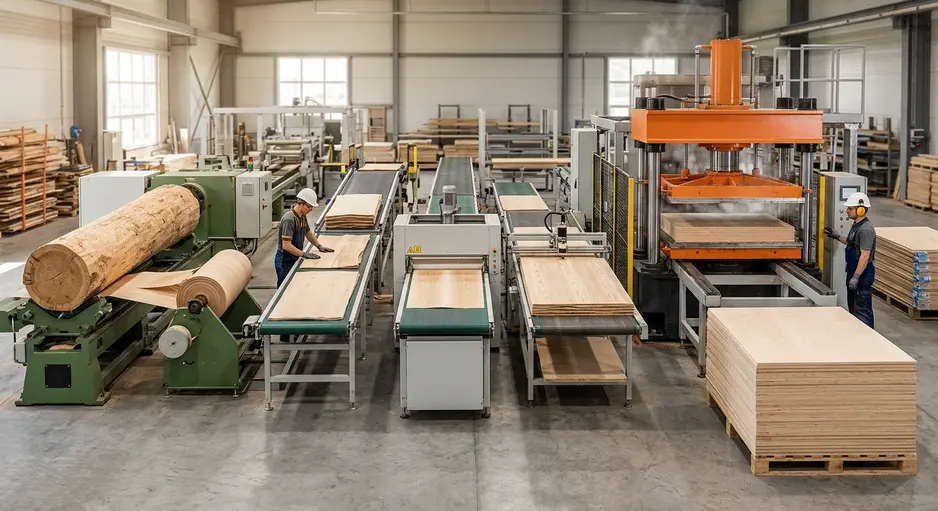
The plywood production process from logs to sheets follows a controlled sequence. While plant layouts may differ, the main plywood manufacturing steps are:
Wood expands and shrinks more across its grain than along it. Alternating the wood grain orientation helps control this movement. It also spreads loads in both panel directions instead of concentrating strength along one direction.
A symmetrical, balanced layup reduces uneven stress and the risk of warping. Many panels have an odd number of plies, although the final construction depends on thickness, grade, and performance requirements.
Good plywood starts with suitable logs. Factory teams inspect species, diameter, straightness, knots, splits, decay, and moisture condition. These factors affect veneer yield, surface appearance, strength, and production cost.
Clear, attractive veneers are often chosen for faces. Veneers with sound but less attractive features may be used inside the panel after repair and grading. Severe knots, decay, or hidden splits can become gaps and weak zones that pressing cannot correct.
Logs are cut, or bucked, into lengths that match the rotary lathe. Mechanical timber log debarking then removes bark, soil, stones, and other debris. Operators must also check for embedded metal.
Clean logs protect knives and other plywood production machinery. They also lower the chance of rough peeling, stained veneer, and unwanted surface marks.
Logs may be soaked, sprayed, or steamed under controlled conditions. Heat and moisture soften the wood, making it easier to peel into a smooth ribbon. Proper conditioning can reduce splits and improve veneer recovery.
The correct treatment varies with species, log diameter, storage history, and moisture condition. Over-conditioning may damage color or wood structure, while poor conditioning can result in rough or cracked veneer.
A rotary veneer lathe grips and rotates the conditioned log against a sharp knife. The wood unwinds into a continuous sheet, much like paper coming off a roll. Lathe settings control veneer thickness and peeling quality.
Knife condition, pressure-bar settings, log centering, and feed speed must remain stable. Poor control can cause rough grain, thickness variation, splits, or lathe checks. These defects may weaken bonding or remain visible after finishing.
The ribbon is clipped into usable sheets. Sections with major splits, holes, or decay are removed. Depending on the grade, smaller pieces may be joined, while defects may be patched or repaired.
Core repair is especially important. An unrepaired inner gap may not be visible on a full sheet, but it can appear when a cabinetmaker cuts the panel. Large voids can also reduce edge quality and screw-holding performance.
Freshly peeled veneers contain too much moisture for reliable gluing. They pass through a veneer dryer until they reach the plant’s validated moisture target.
There is no universal veneer drying temperature. Settings depend on species, veneer thickness, dryer design, speed, and adhesive system. Veneer that remains too wet may cause weak bonds or steam blisters during pressing. Excessive drying can make it brittle and may also affect adhesive performance.
Veneer grading and sorting consider appearance, thickness, grain, repairs, and defects. Smooth, attractive sheets are usually reserved for the face and back. Structurally sound veneers with repaired defects can be placed in the core.
Sorting also helps operators build balanced panels. Mixing unsuitable thicknesses or moisture levels can cause uneven surfaces, internal stress, and poor bonding.
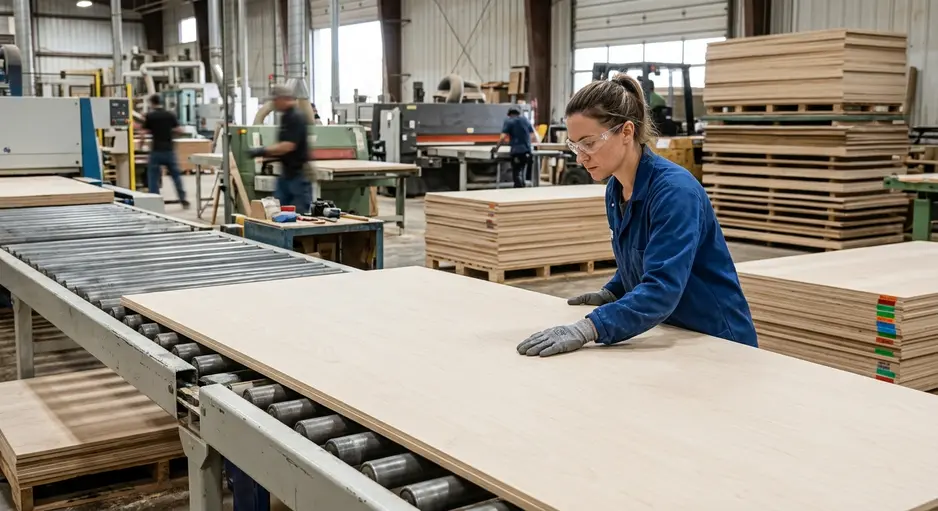
The adhesive must match the panel’s intended use and required standard. Urea-formaldehyde systems are common in many dry interior applications. Melamine-modified resins may provide greater moisture resistance, while phenol-formaldehyde systems are widely associated with exterior or higher-exposure uses.
Manufacturers may also use low-emission formulations to meet applicable rules. Resin chemistry alone does not define performance. Veneer condition, glue spread, pressing, panel construction, and test results must also be considered.
A glue mixer prepares the resin according to a controlled formulation. Roll coaters, curtain systems, or other spreaders then apply a measured amount to the veneer.
Viscosity, spread rate, mixing accuracy, and assembly time require close control. Too little adhesive can create dry spots and delamination. Too much raises cost and may cause excessive squeeze-out or processing problems.
Workers or automated lines arrange face, core, and back veneers according to the layup schedule. Adjacent grains usually run at right angles. Matching layers around the panel center helps keep the construction balanced.
The number and thickness of veneers determine the nominal panel thickness. Incorrect placement can lead to warping, uneven strength, or poor dimensional stability.
Cold pressing plywood means applying pressure before the hot-press cycle. This step brings the glued veneers into closer contact and makes loose assemblies easier to handle. It can also reduce shifting as panels enter the hot press.
Inside the hot press, heat cures the adhesive while pressure creates close contact between veneers. The validated cycle considers resin chemistry, panel thickness, veneer moisture, press design, pressure, temperature, and time.
No single setting works for every product. Inadequate curing may cause weak bonds. Poor moisture control can cause blisters, while excessive pressure may over-compress the wood and alter thickness.
Pressed panels may be conditioned before finishing. Trimming saws square the edges and cut sheets to the required dimensions. Plywood panel thickness calibration then removes small variations and helps the sheet meet the specified tolerance.
Single-side or double-side sanding creates an even surface for furniture, laminates, decorative veneers, paint, or coatings. Excessive sanding must be avoided because it can thin the face veneer and expose lower-grade material.
Depending on the product, the factory may add an overlay, film, treatment, or decorative finish. The final surface should match its stated grade and end use.
Finished sheets are graded, marked, and linked to a batch where traceability systems are used. Export packaging may include pallets, edge protection, secure strapping, and moisture-resistant wrapping suited to the shipping route.
Effective quality control covers the whole plywood factory process rather than relying on a final visual check.
A plywood bonding strength test may involve shear, delamination, water-resistance, boil, or cyclic exposure methods. The correct procedure depends on the grade and governing specification.
ISO 12466, EN 314, EN 636, and national standards such as IS 303 or IS 710 may apply in relevant markets. Visual appearance alone does not prove bond quality. Buyers should compare test reports with the exact product grade they plan to purchase.
Emission requirements vary by market and product. EPA TSCA Title VI, CARB Phase 2, E1 classifications, and national regulations may be relevant. Buyers should ask for current reports from recognized laboratories and verify that the tested construction matches the supplied panel.
Claims such as “zero emission” or “formaldehyde-free” should not be accepted without clear, independent evidence and a defined test method.
For cabinets and modular furniture, buyers should focus on smooth faces, consistent thickness, repaired cores, low emissions, screw-holding performance, and compatibility with laminates or coatings.
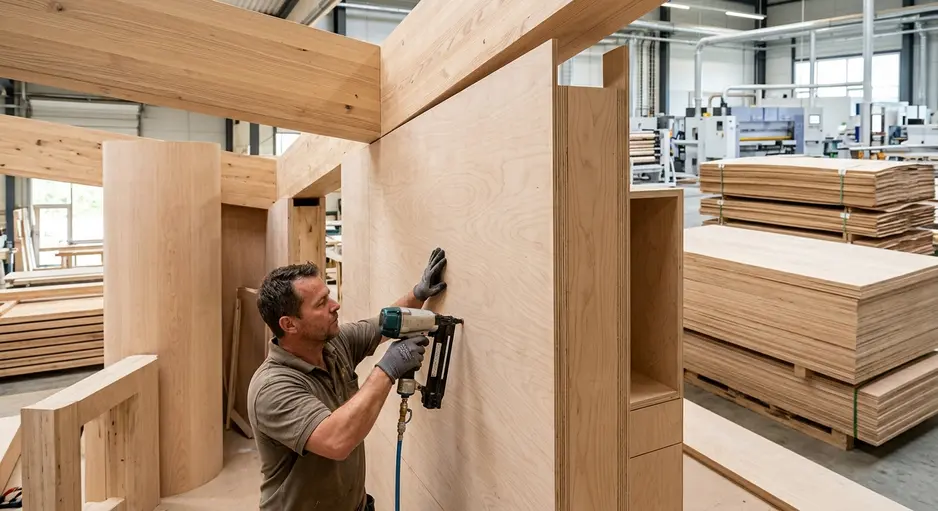
A modern plywood manufacturing plant may use the following equipment:
Automated glue dosing, moisture sensors, press controls, machine vision, and production tracking can improve consistency. However, automation does not replace skilled operators or a documented quality system.
Efficient plants may also improve veneer recovery, reuse suitable wood residue, collect dust, and recover heat. These steps can reduce waste and support stable plywood production.
Plywood manufacturing cost depends on timber species, log recovery, veneer rejection, resin type, energy, labor, dimensions, thickness, and ply count. Testing, certification, finishing, packaging, freight, and export compliance also add cost.
A low-priced sheet may have thinner faces, more core gaps, or less consistent dimensions. Buyers should compare technical specifications and verified performance, not price alone.
Ask potential suppliers for technical data sheets, applicable certifications, samples, and recent third-party reports. Confirm face grade, core construction, adhesive system, tolerances, emissions, capacity, packaging, traceability, and delivery terms.
Furniture manufacturers, distributors, importers, and project buyers can contact Suntek Ply to request current product specifications and sourcing information.
Explore Plywood Manufacturing Process
Understanding how plywood is made reveals why two similar-looking sheets can perform very differently. Reliable quality comes from sound veneers, controlled moisture, balanced layup, even glue application, and validated bonding.
Before choosing a panel, compare its construction, intended use, dimensional tolerance, and test evidence. A well-controlled process provides greater value than relying on appearance, price, or broad waterproof claims alone.
The main steps are log selection, cutting, debarking, conditioning, veneer peeling, clipping, drying, grading, gluing, cross-grained layup, cold pressing, hot pressing, trimming, sanding, testing, and packaging.
Hot press temperature varies with resin chemistry, veneer moisture, panel thickness, equipment, and production speed. Manufacturers should follow the adhesive supplier’s technical guidance and use a validated press cycle rather than one universal setting.
Alternating grain directions distributes strength across both panel directions. It also limits natural wood movement, improving dimensional stability and reducing the risk of splitting or warping.
Common systems include urea-formaldehyde for many dry interiors, melamine-modified resins for greater moisture resistance, and phenol-formaldehyde for exterior or higher-exposure uses. Selection depends on the required grade and standard.
The plywood manufacturing process for the furniture industry emphasizes smooth face veneers, repaired cores, balanced construction, accurate thickness, calibrated sanding, dependable bonding, and suitable emission performance.
